


To Be a Professional Engineer
Relationship between Engineering Education Accreditation and Registration of Professional Engineer.
From the worldwide perspective, an individual to be called as a professional engineer is required to complete “accredited” engineering education programs provided by a higher education institution. The completion of such an education program is a prerequisite and the starting point to be an engineer in the future. This is the internationally shared understanding. JABEE joins the Washington Accord, which is an international framework for the accreditation for engineering education. The Institution of Professional Engineers, Japan(IPEJ) joins the International Professional Engineers Agreement (IPEA) and APEC Engineer, which are international and regional frameworks for the mobility of professional engineers. Under the International Engineering Alliance (IEA), the Washington Accord, IPEA and APEC Engineer have been discussing the consistency from the perspective on quality assurance of international engineers.
The following shows the flow of the processes to be a professional engineer in Japan.
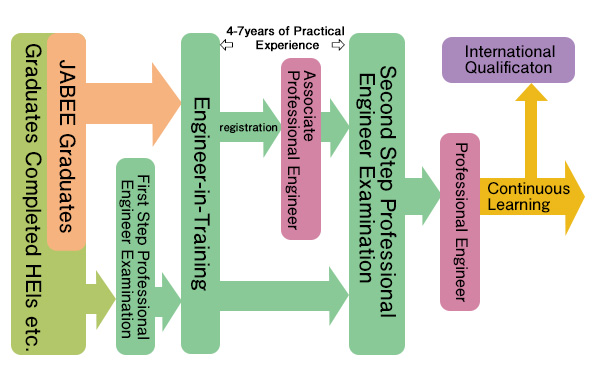
Process to be a Qualified Professional Engineer
A JABEE program graduate is called as an engineer-in-training
For a non-JABEE graduate, another path is available to be an engineer-in-training. If he or she passes the first step professional engineer examination, he or she is called as an engineer-in-training.
An engineer-in-training if he or she registers, is called as an associate professional engineer, which is the qualification of the Japanese Government.
After 4-7 year practical experience, an engineer-in-training is eligible to take the second step professional engineer examination. If he or she passes the second step examination, he or she is registered by the Japanese Government as a professional engineer.
Q & A
For the WA-equivalent Graduates from accreditation to registration.